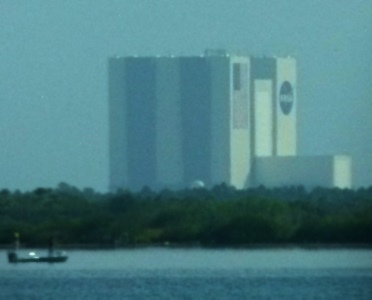
It is used for the assembly of the Shuttle, external tank and solid rocket boosters.
It is 160 meters (525 ft) tall and encloses 3,664,883 cubic meters (129,428,000 cubic feet) of space making it one of the worlds largest buildings by volume.
We had tickets to see the launch from the Kennedy Space Center Visitors Complex.
We got there early so we had plenty of time to see the exhibits.
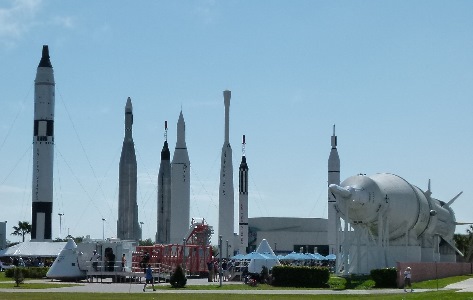
The Rocket Garden is a trip back in time.
From left to right.
1) Titan II GLV
or Gemini-Titan, was used to launch twelve Gemini
missions between 1964 and 1966.
2) Atlas-Agena, was used for 119 orbital launches between 1960 and 1978 including moon probes starting in January 1962
3) Mercury-Atlas 1, first unmanned flight was July 29, 1960 and it's final flight completed 22 Earth orbits May 15, 1963
4) Juno II, attempted 10 earth orbit and lunar probe missions between December 1958 and May 1961, only 5 were successful.
5) Delta, has been the basis of a series of rockets, First launched in 1960 there have been many more than 300 flights.
6) Mercury-Redstone Launch Vehicle, was used for six sub-orbital Mercury flights starting December 1960 with manned flights in May and July 1961
7) Juno I, put the first American satellite, Explorer 1, in orbit in January 1958. It was used for five more flights only two of which achieved orbit.
8) Saturn IB, (horizontal) was used as a test vehicle for the Saturn 5 moon rocket. Its first unmanned launch was in February 1966 and the first manned launch was February 1968.
2) Atlas-Agena, was used for 119 orbital launches between 1960 and 1978 including moon probes starting in January 1962
3) Mercury-Atlas 1, first unmanned flight was July 29, 1960 and it's final flight completed 22 Earth orbits May 15, 1963
4) Juno II, attempted 10 earth orbit and lunar probe missions between December 1958 and May 1961, only 5 were successful.
5) Delta, has been the basis of a series of rockets, First launched in 1960 there have been many more than 300 flights.
6) Mercury-Redstone Launch Vehicle, was used for six sub-orbital Mercury flights starting December 1960 with manned flights in May and July 1961
7) Juno I, put the first American satellite, Explorer 1, in orbit in January 1958. It was used for five more flights only two of which achieved orbit.
8) Saturn IB, (horizontal) was used as a test vehicle for the Saturn 5 moon rocket. Its first unmanned launch was in February 1966 and the first manned launch was February 1968.
A mural showing the International Space Station, ISS, with the flags of the participating countries in the foreground.

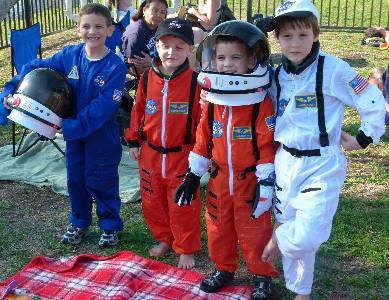
Some future astronauts were on hand for the launch.
We were allowed to board this shuttle.
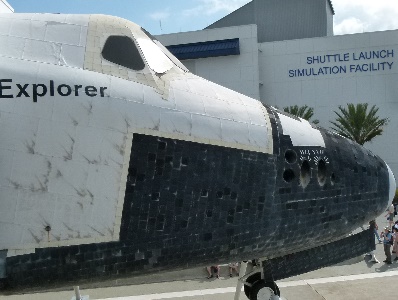
A close view of the thermal protection system (TPS) tiles.
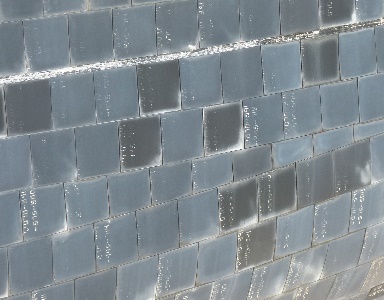
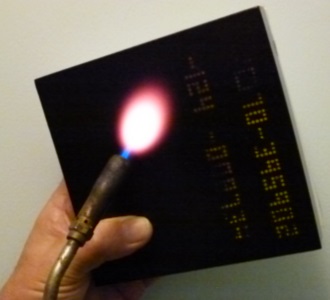
The tiles provide protection from the heat of reentry.
I can't properly simulate that, but here I am holding one while it was heated with a propane torch.
My fingers are against the tile directly behind the hot spot in the second picture and I could not feel the temperature rise at all.

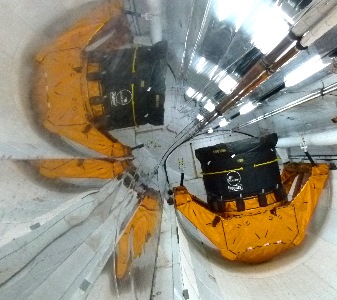
The highly reflective bay doors give a unique perspective of the payload in the cargo bay.
Discovery on the pad. (Photo courtesy of NASA)
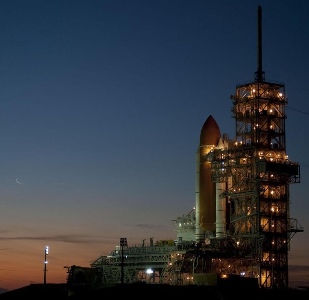
And as seen on the display that was set up at the Visitors Center.
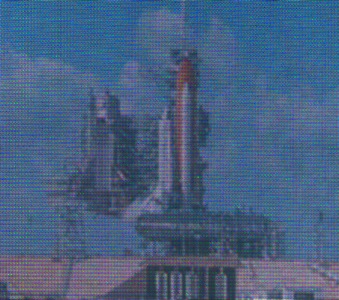
They also had coverage of the docking of the Automated Transfer Vehicle, ATV, Johannes Kepler, with the Space Station.
Had there been problems with this mission it may have delayed the Discovery launch so we were all glad to see it was successful.

The launch was spectacular.
We were advised by one of the guides at the center that we would see the shuttle emerge above the tank at the center of this picture.
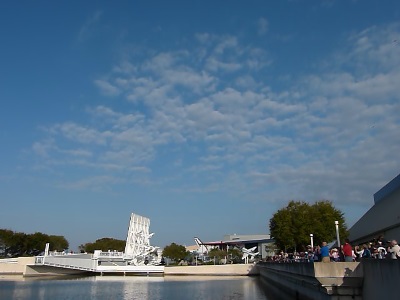
She wasn't quite right.
Our view was nearly blocked by the palm trees on the left but our location did provide a great shot as the shuttle passed behind the flags.
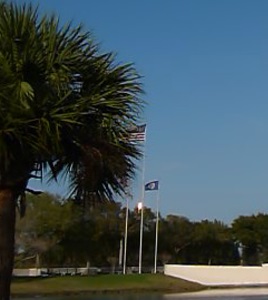
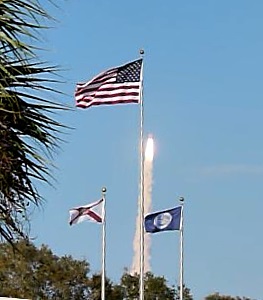
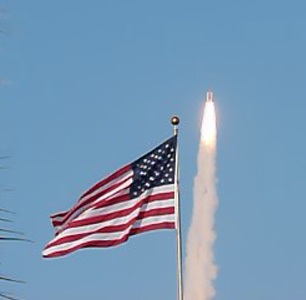
Rising higher.
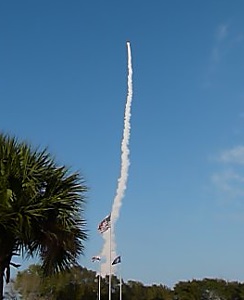
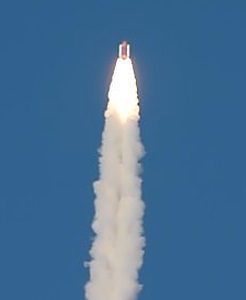
Then it was hidden behind its smoke trail.
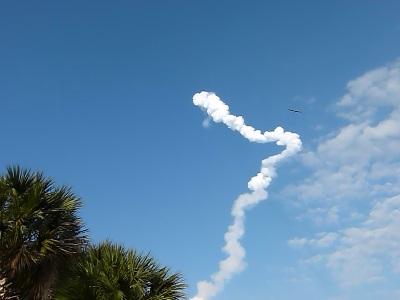
Emerging again
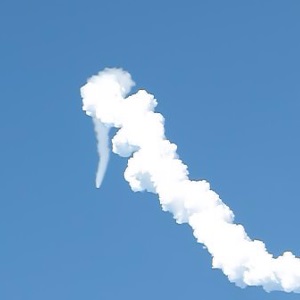
Followed by separation of the Solid Rocket Boosters, SRB, 126 seconds into the flight.
It certainly didn't seem that long.
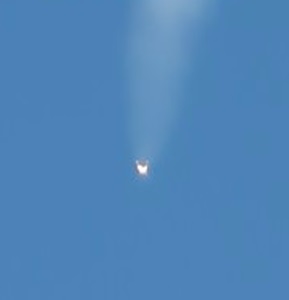
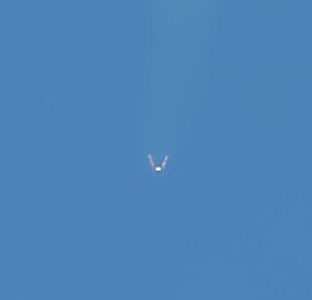
Here is another view of the launch.
This one taken from a plane leaving Orlando.
Neil Monday graciously gave permission for me to include it here. Thanks Neil.
I have run his video through a program to minimize the vibration.
That introduced some other artifacts.
If you want to see the original go to his YouTube page https://youtu.be/GE_USPTmYXM?si=FMH-3Wwao3KU1_mz
Here is a view from the booster rocket.
It
shows the launch, separation, and
descent to the booster's landing
in the ocean.
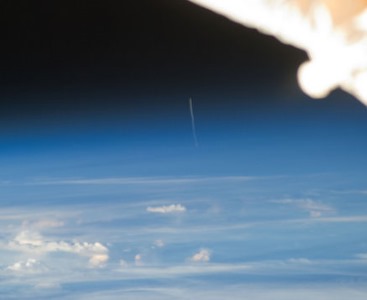
And another launch from even higher up.
This one the Johannes Kepler ATV as
seen from the ISS.And another launch from even higher up.
Taken by astronaut Paolo Nespoli on 16 February 2011.
It is a stale phrase but "Once in a lifetime!" certainly applies to the experience.